Overview

Length

10 weeks

Role

Project manager

Tools

Figma

Team

Deni Simeonov, Haemi Kwon, Thanhtruc Nghiem, Kristine Duong, Megan Powell, Kiro Kilinski

View prototype

Prototype

Case study

Connecting everyone and everything in the palm of your hand.

Sherpa started as out with the foundation of connection. We wanted users to connect on a global scale in order to make their travels easier. Throughout our process, Sherpa evolved into more than connection, it evolved into discovery and planning. In its final form, Sherpa is the only travel app you will ever need.

What did we expect? What were we trying to solve?

The initial pitch for Sherpa revolved all around connecting with local guides to chat and gain some information about travel. I wanted to solve the problem that has arisen in the past decade due to social media, the fact that many discovery tools are now formulated and recycled. When you try to look something up, you'll get similar results each time and it didn't feel genuine, so Sherpa was an attempt to solve that.

What did we end up with?

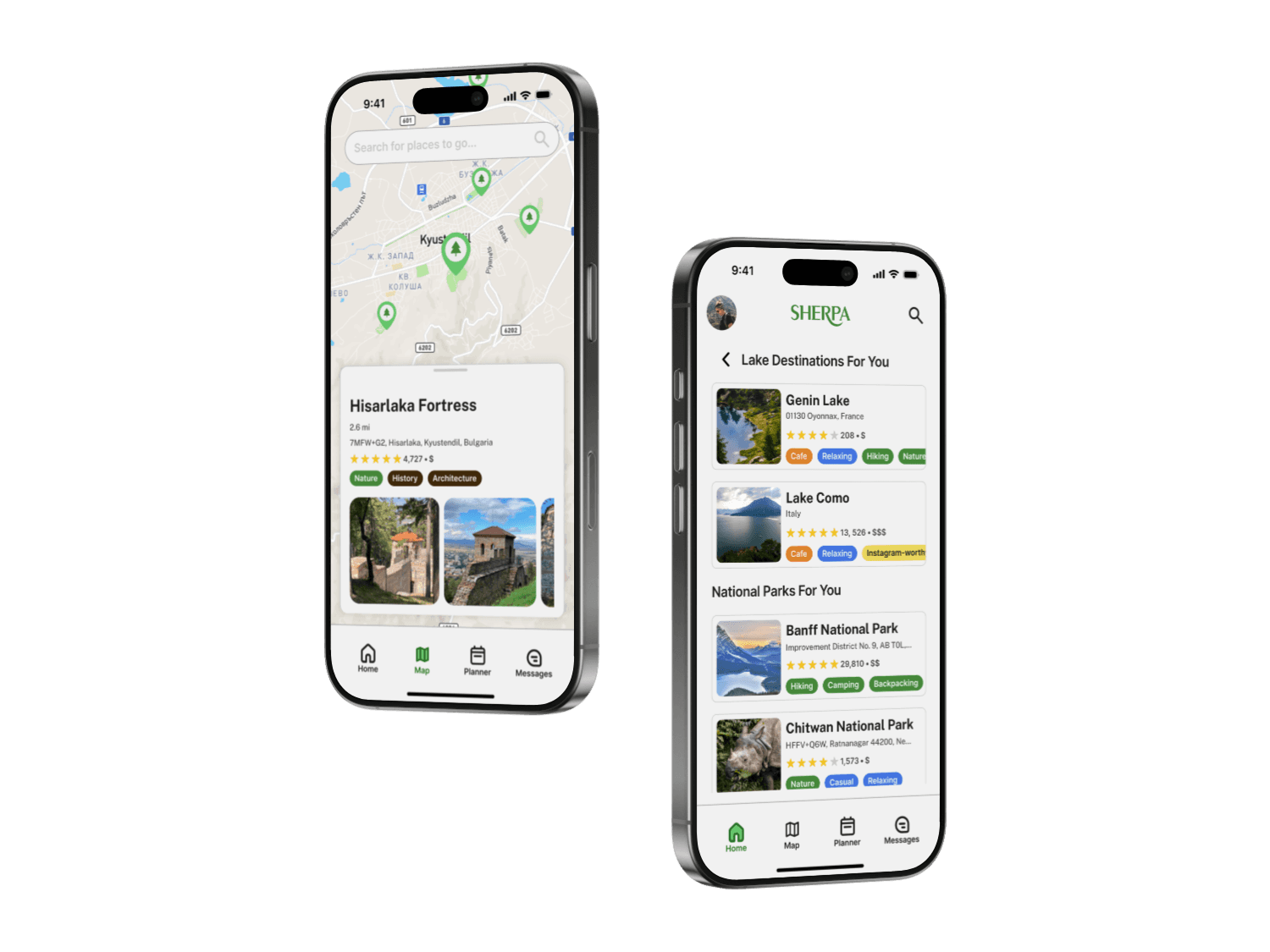
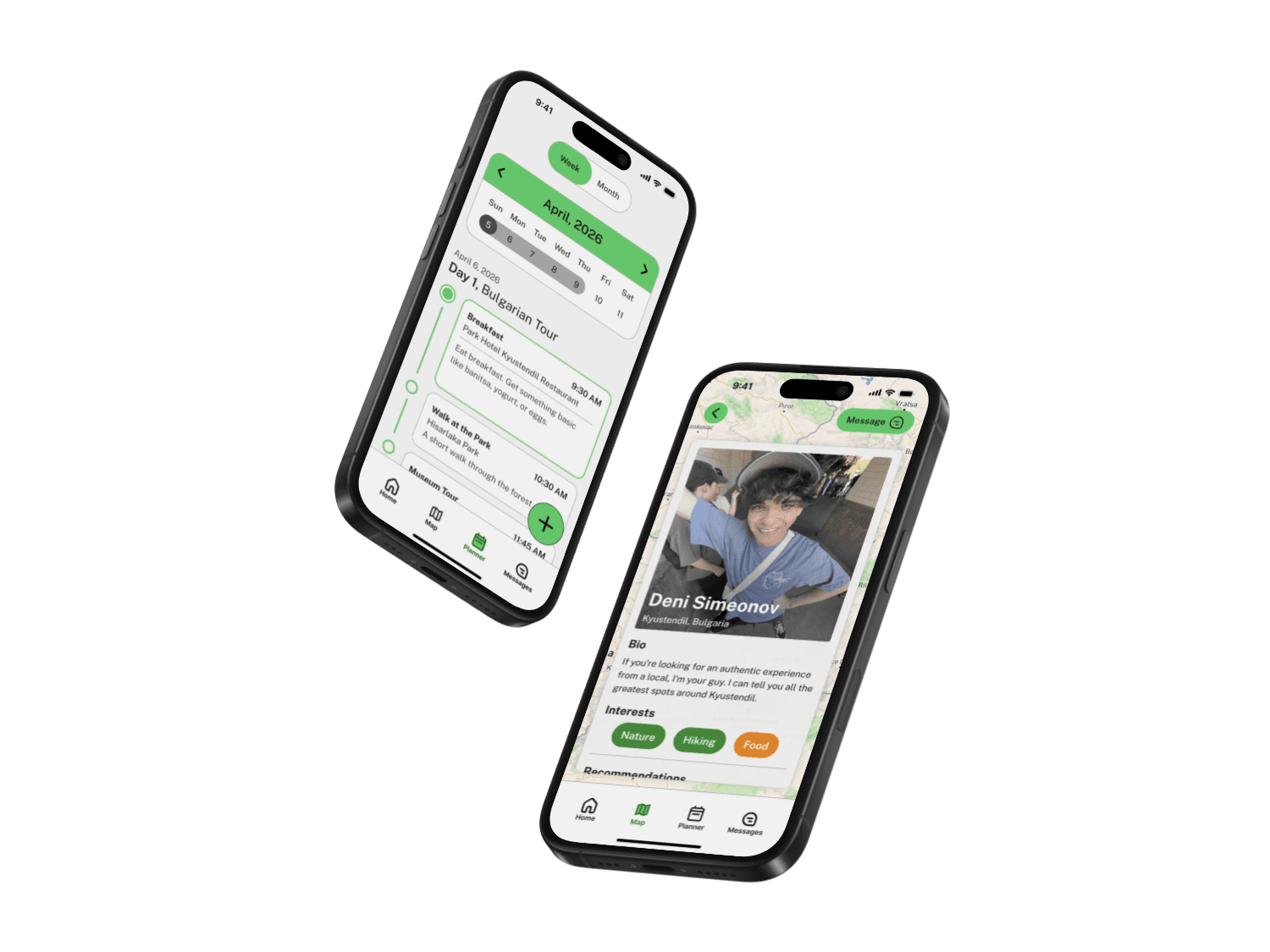
Ultimately our research guided us in a different direction than we originally had planned. The final prototype features an extensive planner and location discovery tools. We shifted our focus to these other features, but we never lost track of our heritage, the connection with local guides.

What did we learn?

We learned that in order to succeed, we have to be adaptable and passionate. Our team strived to create a product that we were all proud of and want to show to the world, but that's only half the challenge. We had to adapt our strategies and brainstorm many times throughout the process becuase of new information we had discovered. We overcame our adversities and ended up with a product that's a result of passion, adaptability, and team work.

Process

Project Motivation

Creating senior project

Project Type

UI/UX project development

Skills Learned/Used

GDD, Figma, project management

View prototype

Prototype

Overview

Background

Where did the idea come from?

Recently in my life, many people had told me of travel experiences they'd had in the past year. The common issue I heard from them is that discovering places to visit felt like a chore and that it was hard to figure out what was right and what was wrong.

Hearing this over and over again, I knew I had something that I could work with. I had a common pain-point that I could try to solve. And thus, Sherpa came to be.

How did the project come about?

It's my senior year of college, my last semester before I'm out in the real world, fending for myself. I had gone into my senior project class knowing that this project would be the culmination of everything I had done so far in my program. There was a lot of weight on my shoulders, knowing that this project was the single most important thing I will have worked on in my life thus far. The pressure was on, but that never held me back from anything.

I setup my pitch for Sherpa, an app to connect users to locals where they'd chat about locations to travel to. I knew I had to sell myself strong to the class, as many other people likely had projects that were just as passionate as mine. The time came, I walked up and presented, and then the storm settled down and I waited. Miraciously, I had 3 new people come up to me willing to join my group, alongside the 2 friends I already had who were down. This is where it started, the formation of the dream team, and the beggining of Sherpa.

Process

Kickoff Meeting and Research

After the initial kickoff meeting, I knew we had to hit the ground running. I could sense that everyone had passion about the idea, but I wasn't so sure if everyone had the same passion while actually CREATING the project. To try and take advantage of this initial spark of passion, I had the team start on the process immediately.

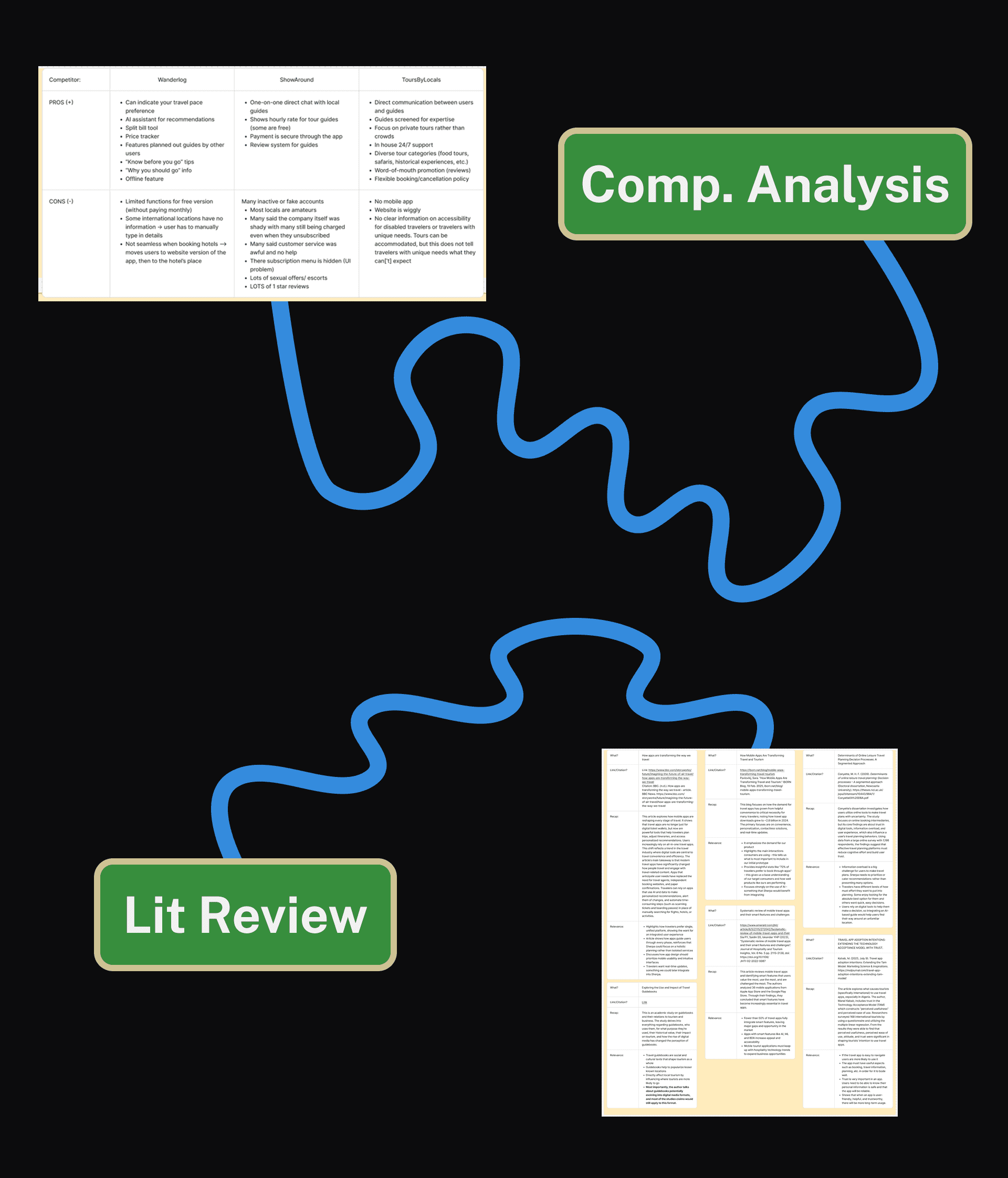
I divided the literature review and competitive audit evenly among everyone as it was a rudimentary step within the process. This strategy was intentional, as it would start pointing me towards the peers I could trust with completing work and those who I had to be more cautious with. I wanted to help everyone see the vision I had for the project, and my goal was to ignite the fire within my peers who didn't have that passion quite yet.

User interviews and persona

As we began to move into more complex and fluid stages of the project, I noticed my first signs of trouble. I tasked everyone with finding 1 suitable candidate for us to interview. Not only this, but I wanted everyone to proctor the interview for their recruited interviewee, as I wanted everyone to learn something from the process. This part of the process was particularly challenging for us, as scheduling interviews that worked with all of our schedules proved to be difficult.

I had also realized that the intial excitement had worn away from my teammates, and that the rest of the project could be increasingly more difficult as the energy dies down. I did my best to push everyone to get their work done, and a majority of my teammates would still communicate well and do what I asked. Everyone managed to get their notes in from the interviews but I knew I still had to shift my management strategies soon.

Requirements

I had realized by this point that when my team was assigned solo work, we would procrastinate and wait until the last minute to do it. This would not only give us lower quality work, but also almost push us back in timing for the original schedule I had set. My next goal was to try and make as much of the future assignments groupwork, this way we could all sit down and get it done together.

This was a success, as we blazed through the requirements phase faster than I originally expected. We sat down in person and had one online meeting to talk about what our persona would need from our service, and it seemed like everyone was excited again to work on the project, as the design portion of the project was right around the corner now.

Wireframing and prototyping

With the initial wireframing, I chose to split the work into asynchronous work again, as everyone seemed to be very enthusiastic about finally designing our prototype. I gave us a weekend to fledge out some basic flows and then we'd refine it in our next in person meeting. It was unfortunately around this time that I had realized some issues arising within the team that I had to try and solve.

The team all had varying levels of understanding of Figma technical skills. A majority of my team had only taken one prototyping class and I was the only one who had worked with some of the more advanced features on Figma. This would severly slow down our prototyping phase if I didn't address the issue and plan around it accordingly. So, I started with a quick rundown of some Figma basics to get everyone up to date, I explained and demonstrated some of the more advanced concepts in Figma that we would be using often, and I decided to assign specific sections of the prototype based on everyones understanding of the program.

Our team had some peaks and troughs during the prototyping phase, but in the end we got it done on time. During our user testing, the team was vigilant, potentially since we were nearing the end of the project. With no more bumps in our path, we managed to reflect some of our user insights into our prototype, and these reflections can be seen in our finalized prototype. The project was done, and we all came out learning something new, just as I had originally hoped.

Refinement phase

With the initial wireframing, I chose to split the work into asynchronous work again, as everyone seemed to be very enthusiastic about finally designing our prototype. I gave us a weekend to fledge out some basic flows and then we'd refine it in our next in person meeting. It was unfortunately around this time that I had realized some issues arising within the team that I had to try and solve.

The team all had varying levels of understanding of Figma technical skills. A majority of my team had only taken one prototyping class and I was the only one who had worked with some of the more advanced features on Figma. This would severly slow down our prototyping phase if I didn't address the issue and plan around it accordingly. So, I started with a quick rundown of some Figma basics to get everyone up to date, I explained and demonstrated some of the more advanced concepts in Figma that we would be using often, and I decided to assign specific sections of the prototype based on everyones understanding of the program.

Our team had some peaks and troughs during the prototyping phase, but in the end we got it done on time. During our user testing, the team was vigilant, potentially since we were nearing the end of the project. With no more bumps in our path, we managed to reflect some of our user insights into our prototype, and these reflections can be seen in our finalized prototype. The project was done, and we all came out learning something new, just as I had originally hoped.

The showcase

With the initial wireframing, I chose to split the work into asynchronous work again, as everyone seemed to be very enthusiastic about finally designing our prototype. I gave us a weekend to fledge out some basic flows and then we'd refine it in our next in person meeting. It was unfortunately around this time that I had realized some issues arising within the team that I had to try and solve.

The team all had varying levels of understanding of Figma technical skills. A majority of my team had only taken one prototyping class and I was the only one who had worked with some of the more advanced features on Figma. This would severly slow down our prototyping phase if I didn't address the issue and plan around it accordingly. So, I started with a quick rundown of some Figma basics to get everyone up to date, I explained and demonstrated some of the more advanced concepts in Figma that we would be using often, and I decided to assign specific sections of the prototype based on everyones understanding of the program.

Our team had some peaks and troughs during the prototyping phase, but in the end we got it done on time. During our user testing, the team was vigilant, potentially since we were nearing the end of the project. With no more bumps in our path, we managed to reflect some of our user insights into our prototype, and these reflections can be seen in our finalized prototype. The project was done, and we all came out learning something new, just as I had originally hoped.

Reflection

What could we have done differently?

Looking past the difficulties of working as a team, there were some things I wish I had done differently as the project manager. I wish that I had tried to pull more opinions from my teammates, as sometimes it felt like they just agreed with what I said rather than challenging my ideas and presenting something new. I also wish that we had a bit more time to delve into certain parts of the prototype more and refine them.

Final thoughts

Overall I'm happier with the finished product than I expected to be. It was a great learning process and I was glad I had the opportunity to guide my team through this project. There was a lot I learned about the design process and leading a team and I'm very glad to have worked with my teammates.

Explore some more